Creating Station Group Nodes
 Use the Create Station Group button to manually create new Station Group Node configurations. A Station Group can contain a collection of devices (for a physical station group) or a collection of stations and liquid device Nodes (for a virtual station group). A device can only exist in a single physical Station Group Node, although it can appear in multiple virtual Station Group Nodes.
CygNet Measurement also provides a system command that can automatically create FMS group Nodes in your system. See the following topic for more information about this option.
See Group Nodes in the CygNet Measurement Concepts section for a more detailed discussion of Station Group Nodes and Station Group Node membership.
See Viewing and Editing Station Group Node Properties for more information about accessing properties for station groups that have already been created.
Creating a New Station Group Node
To create a new station group, open the Nodes menu in FMS Explorer, and then click Create Station Group. A series of dialog boxes will appear, beginning with the Group Definition dialog box.
The following tables list and describe property fields found on the New Group dialog boxes.
(Station) Group Definition
Group Definition is the first dialog box.
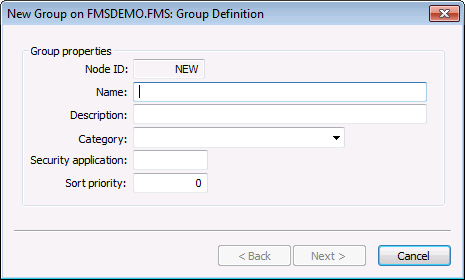
Enter the following group properties to define the new station group.
|
Node ID
|
The system-assigned Node ID for the group. When creating new groups this will indicate NEW.
|
|
Name
|
Type in the name for the new group. The name must be a unique Node identifier system-wide.
Valid characters (maximum of 20) are as follows.
A-Z, a-z, 0-9, . (period), #, $, &, (, ), +, -, \, /, :, <, >, =, @, [, ], ^, {, }, _ (underscore), !, ~ (tilde). Spaces are acceptable, when they are not leading or trailing.
This parameter is required.
|
|
Description
|
Type in a free-form description for the group.
This parameter is optional.
|
|
Category
|
This property enables you to assign an existing category to the group, or to assign a new one. The category places the group within a manually sortable list of groups.
When using CygNet Dispatch, the category property allows groups to be filtered for use with the Dispatch feature set.
This parameter is required when using CygNet Dispatch; otherwise it is optional. See CygNet Dispatch for more information.
|
|
Security application
|
Enter the security application used to validate users of the group. Use this setting to control user access, for example, to only give certain users access to particular groups.
See FMS Security for more information.
This parameter is optional.
|
|
Sort priority
|
Type in the Sort priority number to assign to the group Node. The priority number assigned places it within a manually sortable list. Higher numbers place a Node higher up on a list.
Default value is 0.
This parameter is optional.
|
When you are done, click Next > to access the Station Group Properties dialog box.

Station Group Properties
When the station Group Definition is complete, configure the Station Group Properties, including Station Properties and Station Base Conditions.
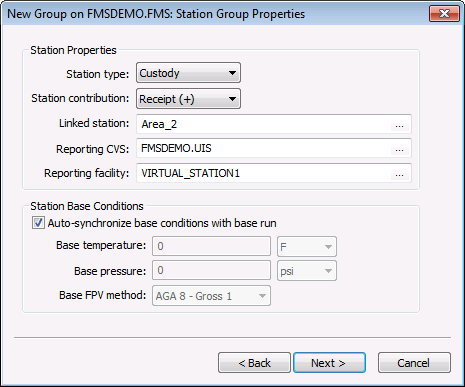
Enter the following properties to describe the new station group.
|
Station type
|
Click to select the group's station type from the drop-down menu.
Options are as follows.
- Custody
- Check
- Interconnect
- Line Pack
- Gas Loss
- Other
- Virtual *
Note: Virtual station group Nodes contain other station Nodes or liquid device Nodes, therefore selection of the Virtual Station type causes changes in the available properties pages.
|
|
Station contribution
|
Click to select the group's station contribution from the drop-down menu to indicate how the selected run contributes to the station.
Options are as follows.
- Delivery (-) Station withdraws from the system
- Receipt (+) Station contributes to the system
Note: Edits to this property can only be applied for the entire span of the Node. An error message will appear if you try to edit this value for a partial span.
|
|
Linked station
|
Click … to access the Select Station dialog box to select from the list of available stations. Select a station to which to link for the purpose of validating data. Click OK.
Example
You might link stations to validate that a custody station and check station are within a known tolerance.
|
|
Reporting CVS
|
Click … to access the Select CVS dialog box to select the reporting current value service from the list. Click OK.
|
|
Reporting facility
|
Click … to access the Select a Facility dialog box to select the reporting facility from a list. Click OK.
|
Station Base Conditions
Enter the following station base conditions to describe a new station group.
Note: This does not apply to virtual station group types.
|
Auto-synchronize base conditions with base run
|
Click to select/clear the check box to auto-synchronize the base conditions with the base run.
Default value is selected.
Clearing the selection enables manual selection of the remaining properties.
|
|
Base temperature
|
Enter the base temperature and temperature units, if not auto-synchronizing with base conditions.
|
|
Base pressure
|
Enter the base pressure and pressure units, if not auto-synchronizing with base conditions.
|
|
Base FPV method
|
Select the base FPV calculation method from the drop-down menu, if not auto-synchronizing with base conditions.
|
When you are done, click Next > to access the Time dialog box.
Time
When the Station Group Properties are complete, configure the Time properties. For data to roll up successfully to the station level, configure exactly the same time property settings for all Nodes belonging to the same physical station group.
Note: The Time menu tab appears for physical station groups but will not appear for virtual station groups, as it does not apply.
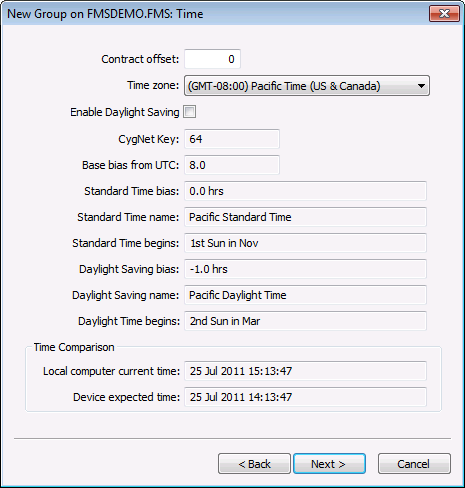
Enter or verify the following time fields for the new physical Station Group Node.
|
Contract offset
|
Type the number (in hours) of the contract hour offset.
This number is synonymous with the Contract time. It is an offset (in hours) from the Device time, describing the hour at which the contract day begins.
|
|
Time zone
|
Click to select the desired time zone from the drop-down menu.
Note: Edits to this property can only be applied for the entire span of the Node. An error message will appear if you try to edit this value for a partial span.
|
|
Enable daylight saving
|
Click to enable an adjustment for daylight saving time.
Notes:
- Edits to this property can only be applied for the entire span of the Node. An error message will appear if you try to edit this value for a partial span.
- This value requires a properly installed CygNetTimeZones.xml file. See CygNetTimeZones.xml File for more information.
|
| Internal time configuration |
|
CygNet Key
|
An internal CygNet identifier
Each time zone is assigned a unique numerical key in the CygNetTimeZones.xml file, located in the CygNet\Services\ARS folder on your host server.
This property is read-only.
Note: This value requires a properly installed CygNetTimeZones.xml file. See CygNetTimeZones.xml File for more information.
|
|
Base bias from UTC
|
The offset in hours between the device's expected time and Coordinated Universal Time (UTC) (also known as Greenwich Mean Time or GMT)
This property is read-only.
|
|
Standard time bias
|
The offset in hours from the base bias to account for standard time in the selected time zone
This property is read-only.
|
|
Standard time name
|
The complete standard time zone name, for example Eastern Standard Time
This property is read-only.
|
|
Standard time begins
|
The date that standard time begins, for example 1st Sun in Nov.
This property is read-only.
|
|
Daylight saving bias
|
The offset in hours between standard time and daylight saving time
This property is read-only.
|
|
Daylight saving name
|
The complete daylight saving time zone name. For example, Pacific Daylight Time
This property is read-only.
|
|
Daylight time begins
|
The date that daylight saving time begins, for example 2nd Sunday in March
This property is read-only.
|
| Time comparison |
|
Local computer current time
|
The time of the client computer
Do not alter the client computer's time; it may cause undesirable changes in your CygNet system.
This property is read-only.
|
|
Device expected time
|
The time expected for the remote device
This property is read-only.
|
When you are done, click Next > to access the Station Group Entries dialog box.
Station Group Entries
When the Time settings are complete, configure the Station Group Entries. Available properties on the pages that appear will vary, depending on whether you are configuring a physical station group or a virtual station group.
Physical Station Group Entries
The following dialog box appears when creating a physical station group. You can configure run properties for physical station groups.
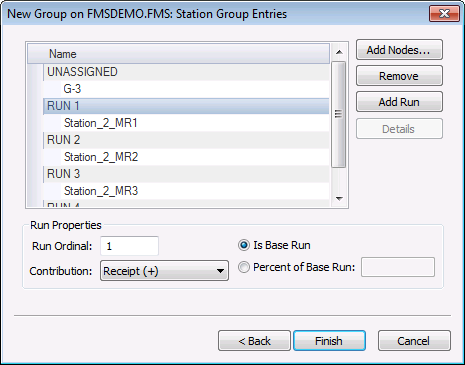
Once Nodes are added to runs in the group, the dialog box will list the meter runs and corresponding Node entries for the new station group.
Note: Typically a run is configured with a single meter assigned. Although multiple meters can be assigned to a run, the subsequent meters are used as check devices. Only the first meter in each run is used for establishing base run properties.
|
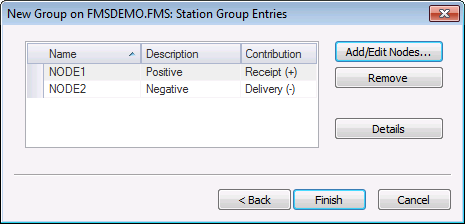
Name
|
Lists the names of the Nodes contained in the station group, and their associated meter runs.
Note: To add Nodes directly to a particular meter run, first click to select the run to which you wish to add Nodes (add the run to the list first, if necessary), and then click Add Nodes and proceed to add them.
|
|
Description
|
Lists descriptions of the Nodes in this station group
|
|
Contribution
|
Lists whether the Node contribution is configured as Receipt (+) or Delivery (-) within this station group.
|
|
Add Nodes
Add/Edit Nodes
|
Click Add Nodes (physical station groups) or Add/Edit Nodes (virtual station groups) to access the Add Nodes to Group dialog box and update group membership, or edit Node contribution value (+/-) if it pertains to a virtual station group.
|
|
Remove
|
Click to remove the selected Node or run from the station group.
|
|
Add Run
|
Click Add Run to add a meter run to a physical station group. Click to select a run to view or edit its Run Properties.
Note: The Add Run button appears only for physical station groups.
|
|
Details
|
Click to select a Node name, and then click Details to access the Record Details dialog box.
|
| Run properties |
|
Run Ordinal
|
View or enter the unique ordinal number associated with the selected run.
|
|
Contribution
|
Click to select a station contribution from the drop-down menu to indicate how the selected run contributes to the station.
Options are as follows.
- Delivery (-) Station withdraws from the system.
- Receipt (+) Station contributes to the system.
Note: Edits to this property can only be applied for the entire span of the Node. An error message will appear if you try to edit this value for a partial span.
|
|
Is Base Run
|
Click Is Base Run to indicate that the selected run is the base run.
Note: Only one run can be the Base Run. Run 1 is set as the base run by default. When you set another run as the base run, assign a Percent of Base Run value to all other runs.
|
|
Percent of Base Run
|
If the selected run is not the base run, click Percent of Base Run, and enter a value in the text box to indicate the run's expected flow. This value must be expressed as a percentage value %, not as a decimal value (for example, enter 14.001 and not .14001 to specify 14.001 %). Acceptable values can have up to seven significant digits.
Default value is 0.
Note: The percentage you specify is relative to the volume of the base run.
|
To add Nodes to a meter run, first click Add Run to add the desired runs to the list. Click to select the run to which you wish to add Nodes, and then click Add Nodes to access the Add Nodes to Group dialog box, and proceed to add them. See Add Nodes to Group for more information.
To remove a Node or run, click to select it, and then click Remove to remove it. A confirmation prompt will appear. Click Yes to confirm the removal.
To add more meter runs to the station, click Add Run. The new run will appear on the list of station group entries.
To change what run a Node belongs to, you have two options.
- Click to select, then click to drag, the selected Node name to the desired meter run.
- Right-click the selected Node name to access a list of available Add to Run options, and then click to select the meter run desired.
Virtual Station Group Entries
The following dialog box appears when creating a virtual station group.
Note: Meter run settings and station base conditions are not applicable fields for virtual station groups. Remaining fields are similar to those for physical station groups, above.
Adding Nodes to a Group
Click to select a run, and then click Add Nodes to access the Add Nodes to Group dialog box to add Nodes to the selected run.
Note: When adding Nodes to a physical station group, the Node will be added to the Unassigned category by default, if no run has been selected to which to add it. The Node must be assigned to a run prior to saving the group.
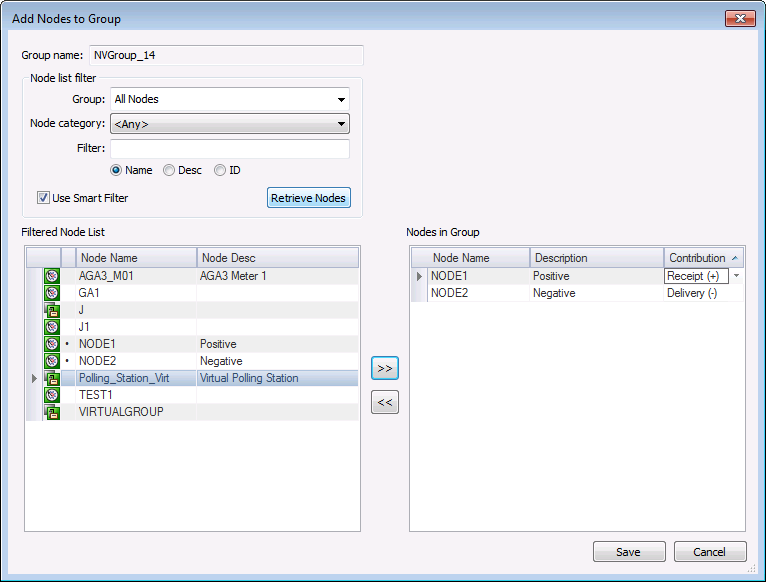
Enter the following information to add Node entries to the new station group.
|
Group name
|
Displays the name of the group to which you are adding Nodes.
|
| Node list filter |
|
Group
|
Click to select the Group filter from the drop-down menu.
Options are as follows.
- All Nodes
- General
- Station
- By Category
Default value is All Nodes.
|
|
Node category
|
Click to select the Node category filter from the drop-down menu.
Options are as follows.
- <Any>
- Group
- Device
- Gas Device
- Liquid Device
- Station
Default value is <Any>.
|
|
Filter
|
Type a filter into the text box, and click the filter type desired.
Options are as follows.
- Name - Node name
- Desc - Node description
- ID - Node ID
Defaults are * (multiple character wildcard) and Name.
|
|
Use Smart Filter
|
Note: This option is not available when using Point in Time mode.
Click the check box to select/clear the use of smart filters to filter Node results. Selection of this option will attempt to display only the Nodes available to be added to the group.
Note: Be aware that this option may not always be entirely accurate, due to the complexities of the historization feature.
|
|
Retrieve Nodes
|
Click to apply the filters selected for Group, Node category, and Filter, and view the results in the Filtered Node List.
|
|
Filtered Node List
|
Lists the filtered Node results, including the following, for each Node listed
- Icon indicating Node type
- Dot icon, if the Node is an entry in the current group
- Node name
- Node description
|
|
Node Name
|
Lists the Node names that meet the defined filter criteria
|
|
Node Desc
|
Lists the descriptions of the Nodes that meet the defined filter criteria
|
| Nodes in Group |
|
Node Name
|
Lists the Nodes which have been selected to be in the group
|
|
Description
|
Lists the Node description
|
|
Contribution
|
The Contribution column appears only for virtual station groups.
Lists the contribution value, whether receipt (+) or delivery (-), within the group
Note: Editing this value does not affect the underlying Node properties.
|
|
>>
|
Click >> to move selected Nodes from the Filtered Node List to the Nodes in Group list.
|
|
<<
|
Click << to move selected Nodes from the Nodes in Group list to the Filtered Node List.
|
|
Save
|
When all Nodes are selected, click Save to add the Nodes and return to the Group Entries dialog box.
|
|
Cancel
|
Click Cancel to close the dialog box without editing entries.
|
Saved groups will appear on the Station Group Entries page.
When you are done, click Finish to access the Save FMS Record dialog box.
Save FMS Record
Once the new Station Group Node properties are configured, you'll be asked to save your changes via the Save FMS Record dialog box. Configure the date and audit information requested to historize the changes in your system.
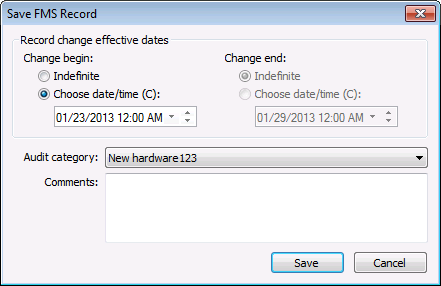
Specify the following parameters to describe the saved record.
|
Change begin
|
Set the effective date and time for the record change to begin.
Options are as follows.
- Indefinite: Click to make the record change begin date and time effective for an undefined amount of time. Effectively, it means all time.
- Choose date/time: Click to make the record change begin date and time effective for a specific date and time. Use the date/time selector to select the specific begin date and time.
|
|
Change end
|
Note: Upon Node creation, this date selection is automatically set to Indefinite. Options become available for edits made to Node properties.
|
|
Audit category
|
Select an appropriate Audit category from the drop-down menu. The audit category type for Node creation is Configuration Change.
Audit categories are configured on the Admin menu. See Configuring Audit Categories for more information.
|
|
Comments
|
Type Comments regarding creation of the Node in the text box. Although comments are optional, they become part of the record and can be helpful when auditing or reviewing records.
|
When all parameters are configured, click Save to save the new station group settings.

